News
-
2026-04-01The dedicated website for Tokyo Metropolitan University GLIDe is now open.
Students engage in multifaceted
study of five specialized fields from
the perspectives of both Human Behavior and Environmental Technology
to develop skills needed for problem solving.
GLIDe at Tokyo Metropolitan University will organically connect the five specialized fields of
Regional Society, International Politics, Development Economics,
Urban Science, and Ecological Conservation to develop human resources
who can perceive the essence of global and urban issues,
go beyond solving issues, and create new value.

Visionary
Message
Cultivate human resources
who GLIDe around the world
Message
who GLIDe around the world
Vice President Masayoshi Noguchi
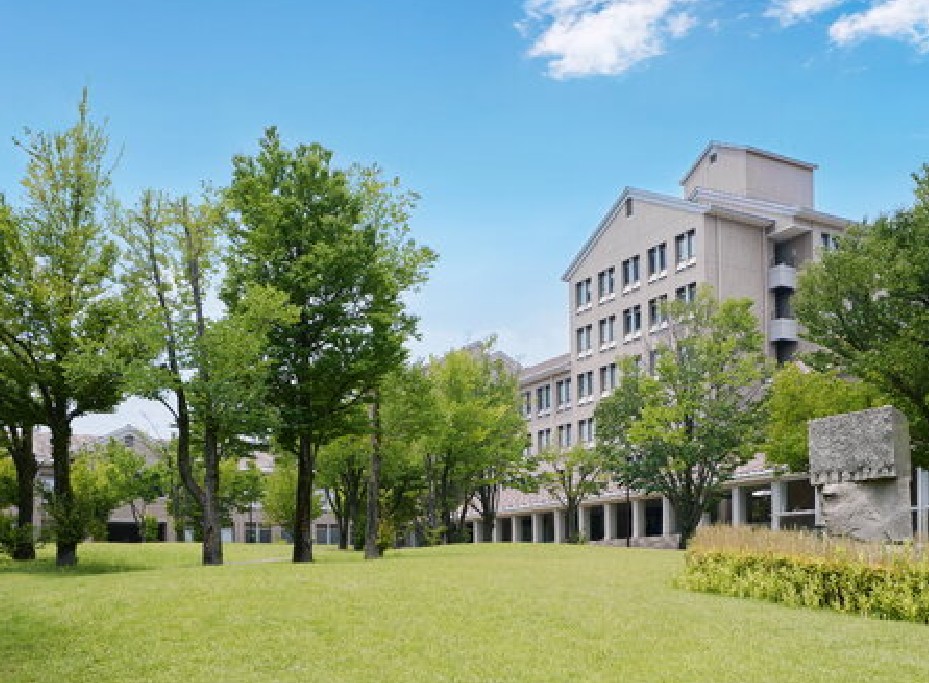
Tokyo Metropolitan University (TMU), the only comprehensive university established by the Tokyo Metropolitan Government, is deeply committed to contributing to the development of Tokyo through strong ties with local communities and innovative research on urban and social challenges.
The Faculty of Global Innovation and Development (GLIDe) was named to reflect its mission to cultivate individuals who can address globally interconnected social issues and contribute to sustainable development by creating new value. The name GLIDe reflects the faculty’s educational philosophy and mission:
• Global represents a perspective that transcends national borders, cultures, and academic disciplines in understanding complex social challenges.
• Innovation signifies the courage and creativity to challenge existing frameworks and generate new solutions.
• Development refers to sustainable progress in its broadest sense, encompassing economic, social, and environmental dimensions.
Through an integrated learning experience grounded in these three pillars, GLIDe equips students with the ability to navigate and respond to the complexities of contemporary society. The abbreviation GLIDe also symbolizes the continuous and dynamic growth of students as they progress through interdisciplinary learning and international collaboration. It conveys the idea of smoothly connecting academic learning with real-world practice, expanding one’s sphere of activity from Tokyo to the global stage.
GLIDe aims to foster globally minded students with broad knowledge and strong communication skills. By learning in English across academic disciplines, students will gain the ability to think flexibly and work across cultures.
This faculty offers a unique platform for tackling global issues such as urban sustainability, innovation, and environmental change. Through a curriculum that blends theory and practice, and with peers from diverse backgrounds, students will be prepared to lead and contribute globally.
We warmly invite motivated students from all backgrounds to take part in this exciting new opportunity and become future leaders in an interconnected world.


The
Academic Core
Features of GLIDe
Academic Core
Learning through
multiple lenses
GLIDe organically connects the study of the five specialized fields of Regional Society, International Politics, Development Economics, Urban Science, and Ecological Conservation to address complex social challenges that no single discipline can solve alone. Students will learn a flexible approach to perceive the essence of issues from multiple perspectives and develop the ability to create new value beyond simply acquiring knowledge.
Learning here
connects you to the world.
English is the primary language of instruction at GLIDe. Students from diverse backgrounds learn together in the same classroom, broadening their perspectives through exposure to different cultures and values. Beyond the classroom, opportunities such as study abroad programs, domestic exchange experiences, and corporate internships foster the global outlook and adaptability needed to thrive in an increasingly interconnected world.
The Curriculum of GLIDe
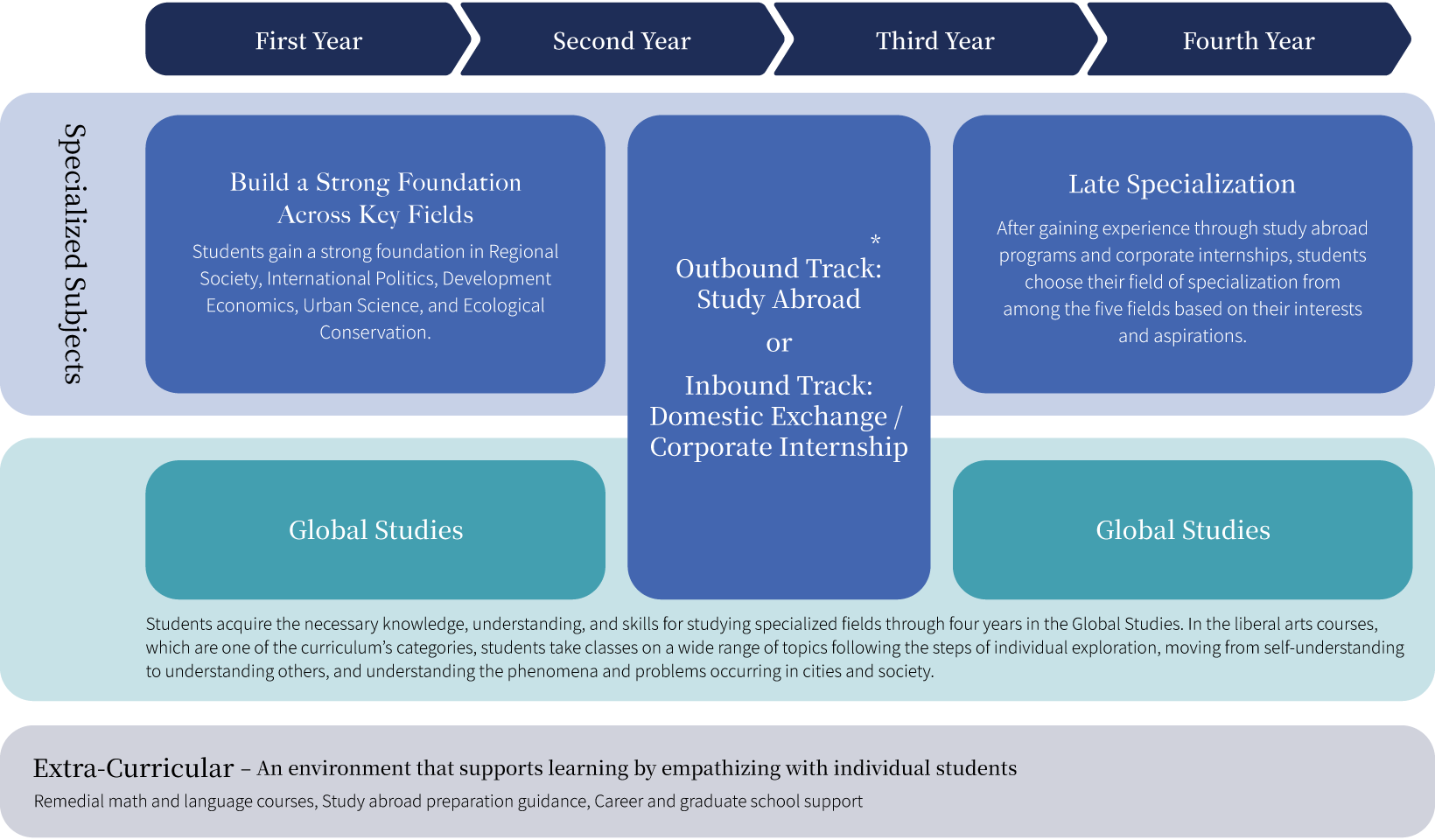
*Outbound Track: Students undertake long-term study abroad while enrolled. This track is intended for students admitted after completing an educational program in Japan.
Inbound Track: Students participate in a domestic exchange and corporate internships while enrolled. This track is intended for students admitted after completing an educational program overseas. Online entrance examinations are planned for applicants who have completed an educational program overseas.
Human Behavior
- Regional Society
- International Politics
- Development Economics
This specialized field studies how humans think, act, and make decisions in society. By studying this field, students can acquire the necessary perspective to build a fair, just, and sustainable society.
Environmental Technology
- Urban Science
- Ecological Conservation
This specialized field studies technology and methods for realizing a comfortable, sustainable life while protecting the natural environment. By studying this field, students consider the balance between the environment and human lifestyles and can acquire the necessary perspective to solve issues.
Domestic Exchange /
Corporate Internships
Corporate Internships
Information on partners will be posted on this website as it becomes available.
-
under preparation
-
under preparation
-
under preparation
Student Support
Scholarships for International Students
TMU offers its own monthly scholarship program etc.
Housing
TMU provides support in arranging student housing to help ensure a suitable and supportive living environment for international students.
Please check the TMU international center website for details.
*The scholarship benefits are subject to change at any time.
Career Path
GLIDe offers learning that looks beyond employment after graduation, supporting pathways that include graduate study in Japan and overseas.
Through learning that applies multiple lenses across the humanities and sciences, as well as international collaboration, each student grows steadily while developing advanced language skills and problem-solving abilities, opening the way to diverse career paths on the global stage.
Potential Career Paths
GLIDe develops the ability to identify the core of complex, uncertain issues and generate new, solution oriented perspectives and ideas. This ability is highly valued across a wide range of fields, both in Japan and internationally.
-

Consulting and think tanks
Analyze social issues and work to formulate and implement solutions
-

Urban development, infrastructure, and transportation
Envision sustainable cities and regions and contribute to their realization
-

Government agencies and international cooperation
Work to solve social issues through the planning and operation of policies and systems
-

IT/DX and Data
Use technology to transform social systems and accelerate problem-solving
-

Finance, insurance, and ESG
Support sustainable social change through investment and financial mechanisms
-

General trading companies and global manufacturers
Create new value through cross-border business activities
-

Graduate study in Japan or overseas
Students can further deepen the questions they develop through practical training and research in the faculty.
-

International organizations (After completing graduate school)
Address global issues with advanced expertise
Overview
Faculty Voices
Messages
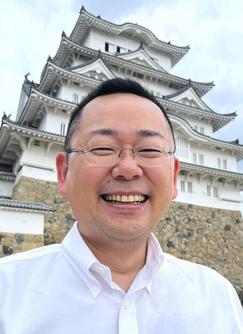
GLIDe Faculty Member
International Politics
Shunsaku Komatsuzaki
GLIDe is a faculty that develops individuals who can transform people and society and make an impact on the world. We are aiming for a future in which, 20 years from now, many GLIDe graduates will be among those changing the world. Tokyo is home to countless seeds of innovation with the potential to reach the world. For those of you who feel that you are not creative, let us acquire specialized knowledge at GLIDe, along with the ways of innovation needed to put it to use, and take flight into the world! For those of you who want to put innovation into action right away, let us make use of the wide range of human and material resources, networks, and opportunities that GLIDe offers, and keep taking on challenges together with your peers! Your field of specialization and your strengths or weaknesses do not matter. If GLIDe’s goals resonate with you, we warmly invite you to learn with us!

GLIDe Faculty Member
Development Economics
Minakshi Keeni
Hello and welcome to GLIDe. I am Dr. Minakshi Keeni, Associate Professor in Development Economics, and I am pleased to introduce a program grounded in the philosophy of “co-creation.” At GLIDe, we approach development economics as a collaborative process of understanding and addressing global challenges such as poverty, inequality, migration, and sustainability.
Our program emphasizes interdisciplinary learning, combining economic theory with real-world applications and policy engagement. Students are encouraged to work across cultures and disciplines to co-create solutions that are inclusive, evidence-based, and impactful.
We expect our students to be curious, analytical, and socially conscious—ready to engage with complex development issues and contribute meaningfully to society. Together, through collaboration and innovation, we aim to shape a more equitable and sustainable future.
Great ideas often start with simple conversations, so let’s talk, think, and create something meaningful together!
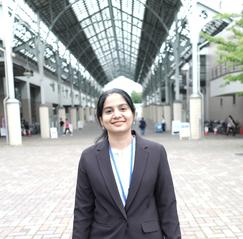
GLIDe Faculty Member
Urban Science
Saritha Padiyedath Gopalan
At GLIDe, we aim to foster a new generation of leaders who can collaboratively address complex global challenges. I mainly focus on water resources management, water-related hazards, and broader hydrological processes, issues that are becoming increasingly critical under climate change and rapid urbanization. Addressing these challenges requires interdisciplinary knowledge, innovative thinking, and international collaboration.
GLIDe offers unique opportunities such as domestic study experiences, industry internships, and project-based learning with global partner universities. Through these opportunities, you will explore how water-related challenges affect societies and environments across different regions and further connect scientific knowledge with real-world applications.
We welcome curious, open-minded, and motivated students to create positive change in society. By learning together in a diverse and dynamic environment, you will develop the skills and mindset needed to co-create solutions for a changing world and help shape the future.
We look forward to learning and working together at GLIDe.
GLIDe Faculty Member
Ecological Conservation
Shigeto Otsuka
A wide range of problems are occurring on this irreplaceable Earth. Climate change, disasters, and environmental destruction are caused by human activities. We still do not know how to truly solve these problems. The four years of university are not merely a period of preparation for employment. They are an excellent opportunity to cultivate the ability to think deeply for yourself about “why such problems occur in the world.” I hope you will learn the wisdom handed down by the generations before us and generate new ideas. And please don’t just master your specialized field; cultivate the ability to engage with and sympathize with people from diverse backgrounds across different areas. It is your curiosity and initiative that will determine Earth's future. We will support your efforts to take on the challenge of solving these problems.
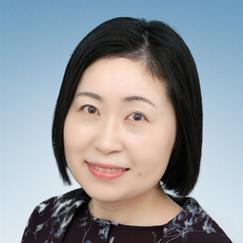
GLIDe Faculty Member
Regional Society
Ayumi Sugimoto
Precisely because different values and cultures meet within them, both challenges and possibilities emerge.
Each of us engages with regional communities through our daily lives, work, and travel, and relationships with others― and in doing so, we also help shape them.
When we turn our attention to the people living on the ground, even global issues reveal deep connections to local communities.
Based in Tokyo, this faculty engages with the dynamism of regional communities while collaborating with universities and companies across Japan and worldwide. Moving beyond the boundaries of the humanities and sciences, we take a practical approach to issues that range from local realities to global challenges.
Through this learning, students cultivate the ability to work with people of diverse values and cultural backgrounds to imagine and create new forms of society together.
We invite you to join us in deepening inquiry, sharing questions, and exploring the future as active participants in society.
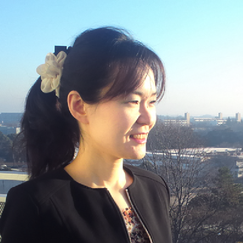
GLIDe Faculty Member
Urban Science
Hyunyoung Lee
I believe one of GLIDe’s strengths is that students can develop the ability to study a specific field in depth while also understanding it broadly in relation to other fields and society.
This kind of learning requires an attitude of engaging in dialogue with people in different positions and thinking, while connecting diverse perspectives.
For example, in energy management, learning about technology is of course important, but it is also important to consider how that technology is accepted, operated, and expanded within local communities.
I hope we can cultivate together the ability to move among diverse perspectives, such as policies and systems, markets, and people’s behavior, to identify the essence of issues across fields, envision improvements, and create new value.
Learning in English is also an important means of broadening this kind of perspective.
We welcome students who are motivated to engage in this kind of learning.
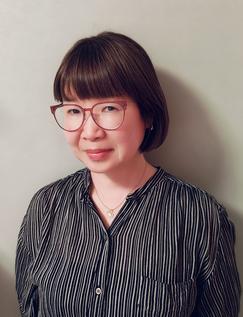
GLIDe Faculty Member
International Politics
Yoshiko Naiki
My lecture and seminar are driven by basic questions: Who are governors of the globe? How do they govern the globe? Actually, these are not new questions. We have been tackling these questions for a long time. One big difference from the past is technological innovation (AI, facial recognition, blockchain etc). We can ask additional questions: How are new technologies reshaping the globe? Who wields power in technological changes? Is the power in hands of global digital corporations? Then, what is the role of international law in the digital age? To address these issues, a good start is to imagine how you are connected to the global society. Consider “global supply chains.” You are one important actor as consumers across global supply chains. Currently, global supply chains are also managed by a digital infrastructure with data sharing technologies. Join us if you are interested in technology, sustainability, and governance!